Hongsheng Zhang, a researcher at Jinan University in China, has published work arguing that travelling into one's own past is impossible across a wide range of theoretical universes, Euronews.com reports. His paper, which has been submitted for peer review, sets out conditions under which the geometry of spacetime forbids so-called closed timelike curves — paths that return a traveller to the exact place and moment they departed. The findings were reported by Euronews.com on 9 November 2026.
Zhang's argument rests on a single observation about light. As he puts it, light can never point sideways relative to a traveller's direction through time. If spacetime can be sliced into layers along which light itself can travel, then anything moving slower than light must cross those layers in the same direction — comparable, in his description, to climbing a staircase that offers no way back down.
Why it matters
The question Zhang addresses is narrower than the familiar science-fiction version. Rather than asking whether a time machine could ever be built, he asks when a given spacetime permits a closed loop at all, and when its geometry rules one out. That distinction matters because Einstein's field equations do allow such paths in some scenarios — for instance near the core of a rotating black hole — so the debate turns on which solutions describe physically plausible universes.
Zhang framed the work carefully. "This is not a claim that time travel is impossible," he said, according to Euronews.com. His contribution is a boundary: a demonstration that in a broad class of universes, the past is out of reach.
Two loopholes, and why one worries him more
The paper also identifies precisely how a time machine could sidestep the restriction, and Euronews.com reports there are only two routes.
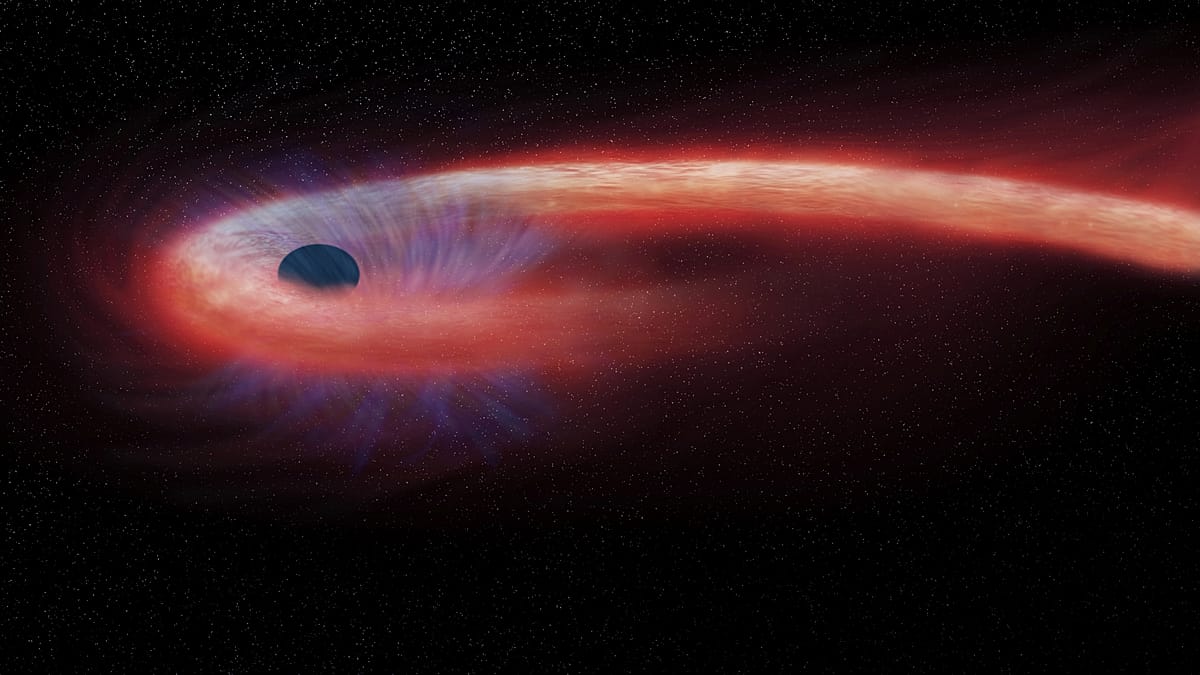
The first is torsion. Picture light rays that twist around one another like the strands of a rope instead of running parallel. When that happens, the regular light surfaces cannot form, and the staircase that would force a traveller to keep moving forward no longer exists. This is what occurs near the centre of a rotating black hole, where, in Einstein's account, a spinning mass drags space and time along with it so strongly that motion "forward" in time is bent into a circle. The physicist Brandon Carter showed in 1968 that such loops exist inside rotating black holes.
Zhang is quick to say torsion is not the culprit. On its own, he told Euronews.com, it does not create a closed curve — it merely blocks his argument. Torsion, he noted, is present throughout the universe and appears harmless as far as is known.
The second route concerns the shape of the universe itself. The staircase may be perfectly built but wrap around a building, so that the top step leads straight back to the bottom — the impossible stairs of an Escher drawing. A traveller would keep climbing and still end up where they began. Most time machines physicists have designed on paper, including those built from wormholes, rely on this trick. Researchers call the loophole topology, and Zhang considers it the one deserving most attention. It is, he said, the loophole that seems least likely to arise without deliberate engineering.
Forward is a different matter
Travel into the future, by contrast, is well established. Einstein showed that moving very fast, or remaining in a strong gravitational field, slows a clock relative to everyone else's. According to the European Space Agency, astronauts returning from six months aboard the International Space Station are roughly five thousandths of a second younger than they would otherwise have been.
Zhang's paper joins a broader conversation about which solutions to Einstein's equations describe reality and which are mathematical curiosities. The distinction between torsion and topology gives researchers a sharper question to pursue: not whether closed loops can exist on paper, but whether the universe's actual shape could produce one without being engineered.
The next step is peer review, where the argument's treatment of the broad class of universes it covers will face scrutiny from other physicists.